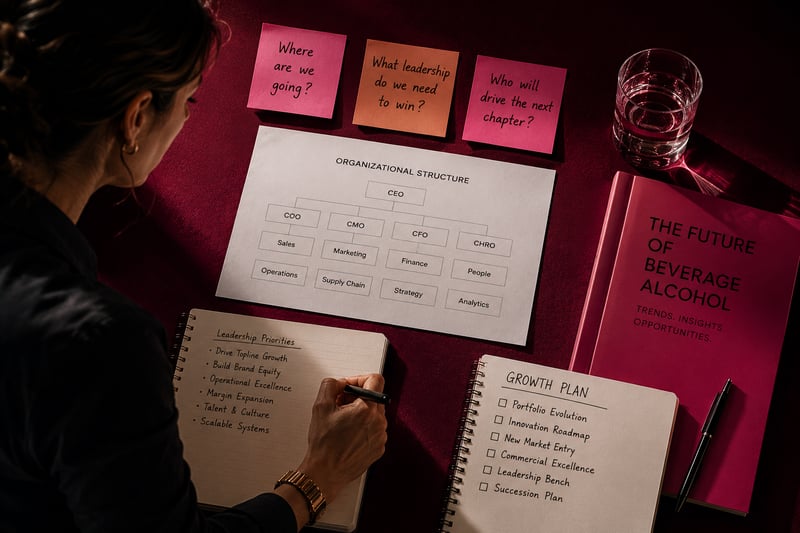
The market has shifted. The brands growing through it are not the ones waiting for conditions to improve. They are the ones making earlier, clearer decisions about who needs to lead the next stage of the business.
Recently, a mature wine company came to us in the middle of a portfolio turnaround. For too long, the team had been trying to carry the weight of a commercial and marketing revamp without the right leadership in place. They had not had a true CMO for quite some time, and they kept telling themselves they could get there with the team they had. By the time we were pulled in, the business was already heading into a key milestone, and the cost of waiting was showing up in slower execution, delayed strategic progress, and a longer road to turnaround than the company could afford.
That pattern is not unusual. What is concerning is how often leadership gaps are left unaddressed until the business is already feeling the consequences.
In uncertain markets, it becomes easier to justify waiting. Teams convince themselves they need more information, more stability, or more time before making a leadership decision. On paper, that sounds reasonable. In practice, it often becomes a costly delay.
Beverage alcohol in 2026: what the numbers say
Wine sales in 2025 came in at 329 million cases, down from 335.9 million the year before. Market value dropped from $75.5 billion to $74.3 billion. Gallup recorded that only 54% of Americans consume alcohol today, the lowest share in 90 years. (Silicon Valley Bank, State of the U.S. Wine Industry, 2026; Gallup, 2024.) When the ground is shifting, waiting can feel like the safer choice.
From where we sit at ForceBrands, advising beverage alcohol and broader consumer brands on leadership, org design, and executive hiring, it usually is not. The brands pulling ahead are not waiting for certainty. They are evaluating what the business will need next and making people decisions before urgency forces their hand. The ones losing ground are often doing the opposite. They are staying reactive, and that comes with a price.
The beverage alcohol consumer has changed. Most companies have not.
The contraction story is real, but incomplete. Younger consumers are drinking less often, and when they do, they are spending more intentionally and making different choices. Spirit-based RTDs grew more than 25% in 2025. Tequila and agave continue to gain share. Premium is outperforming standard across categories. (Silicon Valley Bank, State of the U.S. Wine Industry, 2026.)
The opportunity is still there. But pursuing it requires a different kind of organization than the one many brands built when volume was more predictable, the core consumer was more consistent, and distribution was more stable.
That is where many leadership teams get stuck. They recognize that the market has changed, but they have not fully assessed whether the structure and leadership around them have changed with it. They delay hiring and structural decisions because they are still trying to define where the business is going. But in many cases, the business does not get clearer until the right leadership is in place.
Rob McMillan, who has written the SVB wine industry report for 25 years, put it plainly in his 2026 edition: this is not a cycle you can wait out. I think that is especially important from a people strategy standpoint. The structure, the leadership, and the team composition cannot wait for the market to stabilize. In beverage alcohol right now, the market is not going to stabilize first.
The leadership gap most beverage alcohol brands are ignoring.
Every year, ForceBrands surveys founders, CEOs, C-suite executives, VPs, and senior operators across food, beverage, and adjacent categories. Two findings from our most recent research deserve attention.
More than half of senior leaders are open to leaving their current role in the next twelve months. Two-thirds say their company has no plan in place if they do. (ForceBrands C-Suite Salaries and Executive Sentiment, 2026.)
A reactive search in this market can take six months or more. If a key leader exits and you are starting from zero, you are not just backfilling a role. You are falling behind on the next milestone, often at a moment when the business can least afford it.
To me, that is one of the most underestimated risks in beverage alcohol right now. Not just the market. Not just the consumer. The leadership bench you have not pressure-tested yet.
Succession planning is not an HR task. It is part of the growth strategy.
We pushed further on succession specifically. Only 13% of companies have a formal plan in place for their top three strategic roles. Half have no plan at all. (ForceBrands State of the High-Growth Consumer Brands Industry Report, 2025.)
What stands out is not just the number. It is what leaders say when they reflect on it. More than one in three told us their biggest regret was waiting too long to make a leadership change. Not making the wrong hire. Waiting too long to act on something they already knew. Among CEOs, that number climbs to nearly half. (ForceBrands State of the High-Growth Consumer Brands Industry Report, 2025.)
The idea of half of CEOs is one I keep thinking about. The cost of delay rarely shows up all at once. It shows up in a missed planning cycle. A slower turnaround. A launch that is not fully supported. A board conversation that becomes harder than it needed to be. A capital raise or strategic process that loses momentum because the leadership story is no longer clear.
These are not abstract risks. These are the kinds of calls we get after a business has already lost valuable time.
Succession is not paperwork. It is one of the highest-leverage growth decisions a leadership team can make, and too many brands still treat it as something to address later.
Decision delay has a specific cost. Our data shows where it shows up.
The leadership gaps that create these situations rarely happen by accident. Our research found that 60% of leaders delayed a hiring or structural decision in the past year because they lacked clarity on what they were building toward. Not budget. Not market conditions. Uncertainty about direction. (ForceBrands State of the High-Growth Consumer Brands Industry Report, 2025.)
That uncertainty is expensive. Four in ten leaders told us that unresolved team gaps directly delayed a major milestone, whether a capital raise, a product launch, or entry into a new market. When we asked which functions were most often tied to those delays, Sales and Marketing came up first, even in organizations where leaders believed they had capable people in those roles. (ForceBrands State of the High-Growth Consumer Brands Industry Report, 2025.)
This is the mistake I see most often: brands stay focused on the immediate gap in front of them instead of stepping back and asking what the business will actually require to scale. They stay reactive. They try to preserve the current structure a little longer. They assume they can stretch the existing team. They wait until the pain becomes obvious.
What they fail to realize is that reactive leadership decisions almost always cost more than proactive ones. If you miss the timing, there is a strong chance you miss the consumer, the market, or the moment your business needed to move.
What the beverage alcohol brands getting this right are doing
The brands navigating this well are not necessarily better resourced. They are just asking harder questions earlier.
- First, they take a bigger-picture view of the organization before launching a search. Not just the job description. The structure. The capabilities. The gaps. They ask what kind of leadership the business will need for the next stage, not just who can keep things moving right now.
- Second, they seek outside perspective earlier. They consult their board. They pressure-test their assumptions. They ask talent advisors and leadership partners what other brands have done successfully at similar moments of scale or turnaround. They understand that people strategy is not separate from business strategy. It is part of it.
- Third, they do a more honest evaluation of executive capability. They are willing to ask whether the team in place is truly built for what comes next. That is not a criticism of the people who helped build the business. It is the reality of growth. Different stages require different leadership. The leader who was right for one chapter is not automatically the right leader for the next.
- And finally, they treat succession as an ongoing conversation, not an emergency response. They know where the bench is strong, where it is thin, and where they may need help from outside the organization before a gap becomes urgent.
The consumer brands that move early have options. The ones that wait are managing consequences.
That is one of the clearest patterns I have seen over years of doing this work. The brands that call early have room to think strategically. They can design the role correctly. They can evaluate the team honestly. They can make a stronger hire. They can manage the transition with less disruption.
Companies that wait are usually solving for a problem that has already spread. By then, it is no longer just a hiring decision. It is a commercial problem. A momentum problem. Sometimes a credibility problem.
The top-performing brands in this market are not always the smartest or the biggest. Very often, they are simply the ones willing to act sooner. They face the hard questions earlier. They ask where the business is going, whether the current team can get them there, and what needs to change before the market forces the answer.
The shifting beverage alcohol landscape demands action, not patience. The most successful brands aren't waiting for the market to stabilize; they are stabilizing their own leadership first.
Contact us today to discuss the people strategy for your brand and ensure your leadership is built for the next stage of growth.